Standard lengths of women’s bracelets
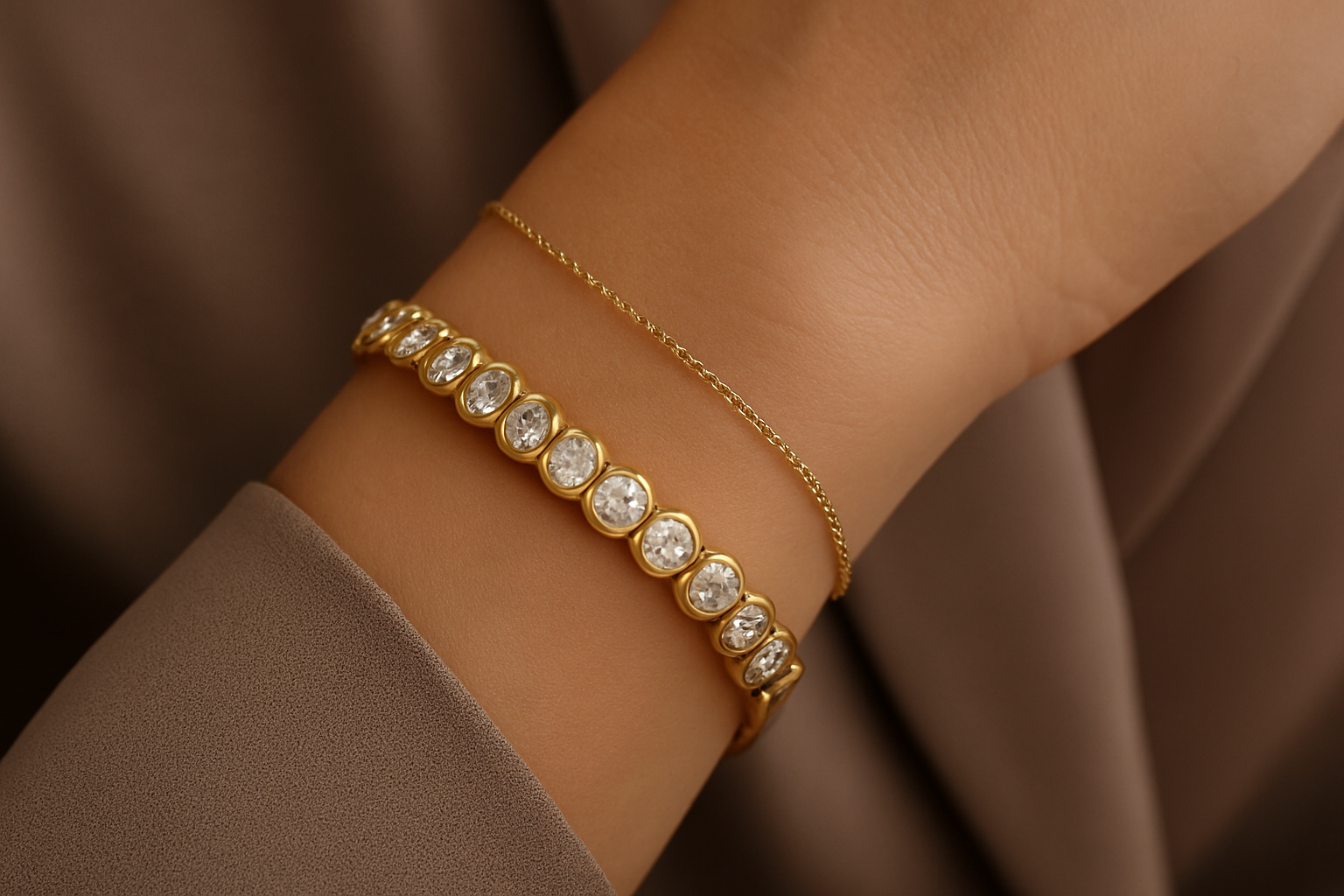
A woman’s wrist is 16 cm on average, therefore 17 cm long bracelets with diamonds fit comfortably, while 18 cm provides looseness when combining with other gold bracelets. A bracelet that is too long falls on the hand and wears out faster.
Men’s bracelets: dimensions of comfort
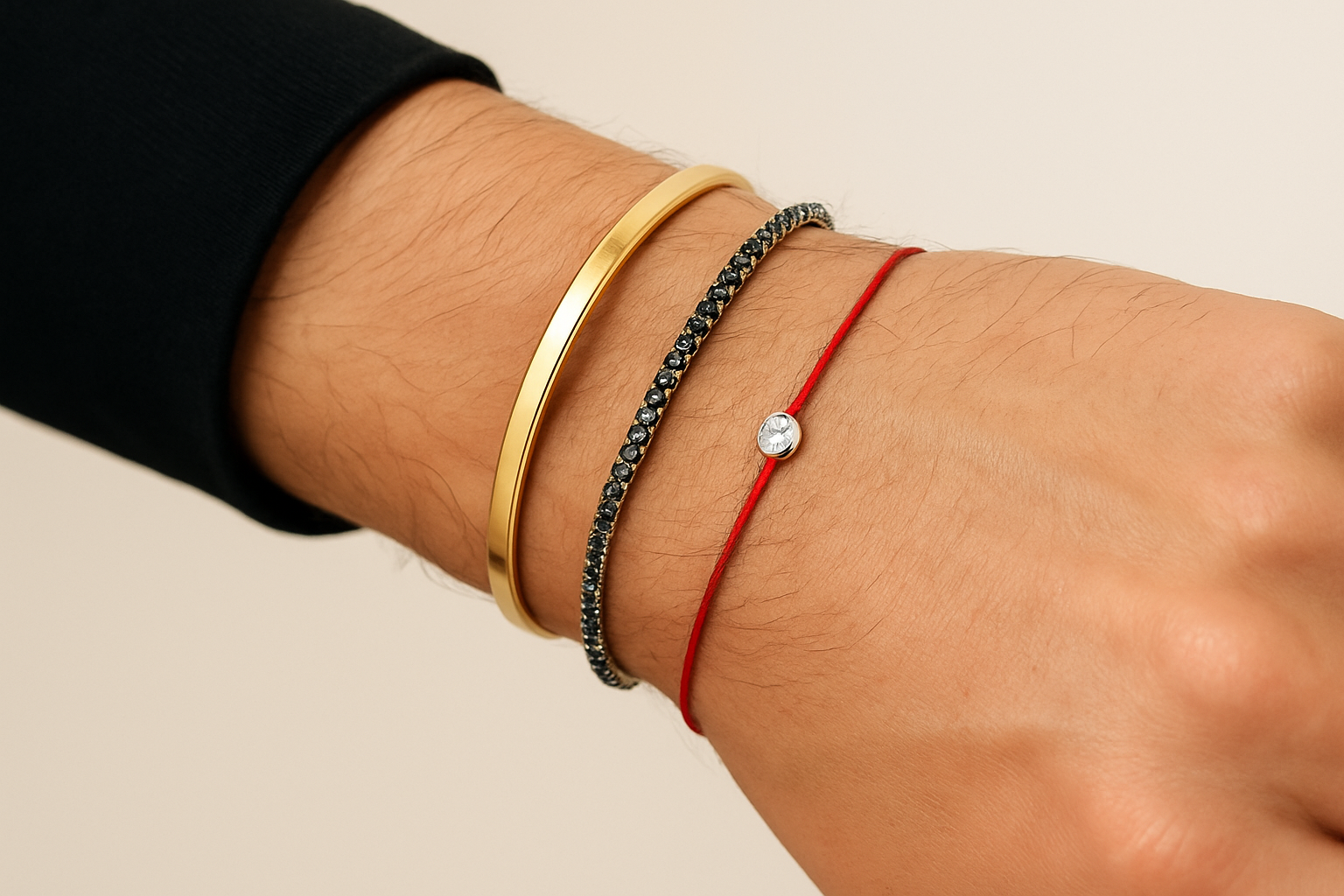
Men’s gold bracelets are usually made 20–22 cm long. A shorter one constricts, a longer one moves back and forth and the clasp may loosen. Gold bracelets with diamonds should be sturdy enough, but not too heavy, so as not to tire the wrist. Our experience shows that a 585 gold bracelet, weighing from 4 g for women and from 6 g for men, creates the right balance between durability and comfort.
Flexibility test
A high-quality bracelet should fall freely on the palm, but when held by one end it should not twist. Too stiff – uncomfortable, too loose – a risk of losing diamonds.
Red string bracelet with a diamond – traditions
A red string bracelet with a diamond symbolises protection. Traditionally, a red string is tied on the left wrist for protection against negative energy. Optimal length – to wrap around the wrist +1 cm for knots. The downside – the string wears out faster than gold, so change it annually.
String bracelets for children
String bracelets for children with a 0,02 ct brilliant-cut diamond are safe if the knot is tight and the diamond is set into a small gold disc. Length ‑ wrist +0,5 cm.
Individual size according to the wrist
Measure the wrist with a string and add 1 cm ‑ this will ensure that the gold bracelet will not dig in, but also won’t slide onto the hand.
Clasps: lobster, box‑lock and magnetic
A lobster clasp is sturdy, but heavier; a box‑lock closes on a lock principle and has an additional safety, a magnetic clasp is convenient, but not suitable if worn next to electronics.
Bracelet thickness and diamond size
A bracelet of 2,5 mm thickness accommodates stones up to 0,05 ct, a 3,2 mm bracelet fits up to 0,10 ct. Larger brilliant-cut diamonds require a wider metal frame.
Gold weight – do not overdo it
A too light ( < 3 g) white gold bracelet can stretch, while an extremely heavy ( > 10 g) yellow gold construction tires the joint. It is recommended to choose a gold weight that makes up 50–60 % of the total mass of the bracelet, leaving the rest for the diamonds.
Classic tennis bracelet
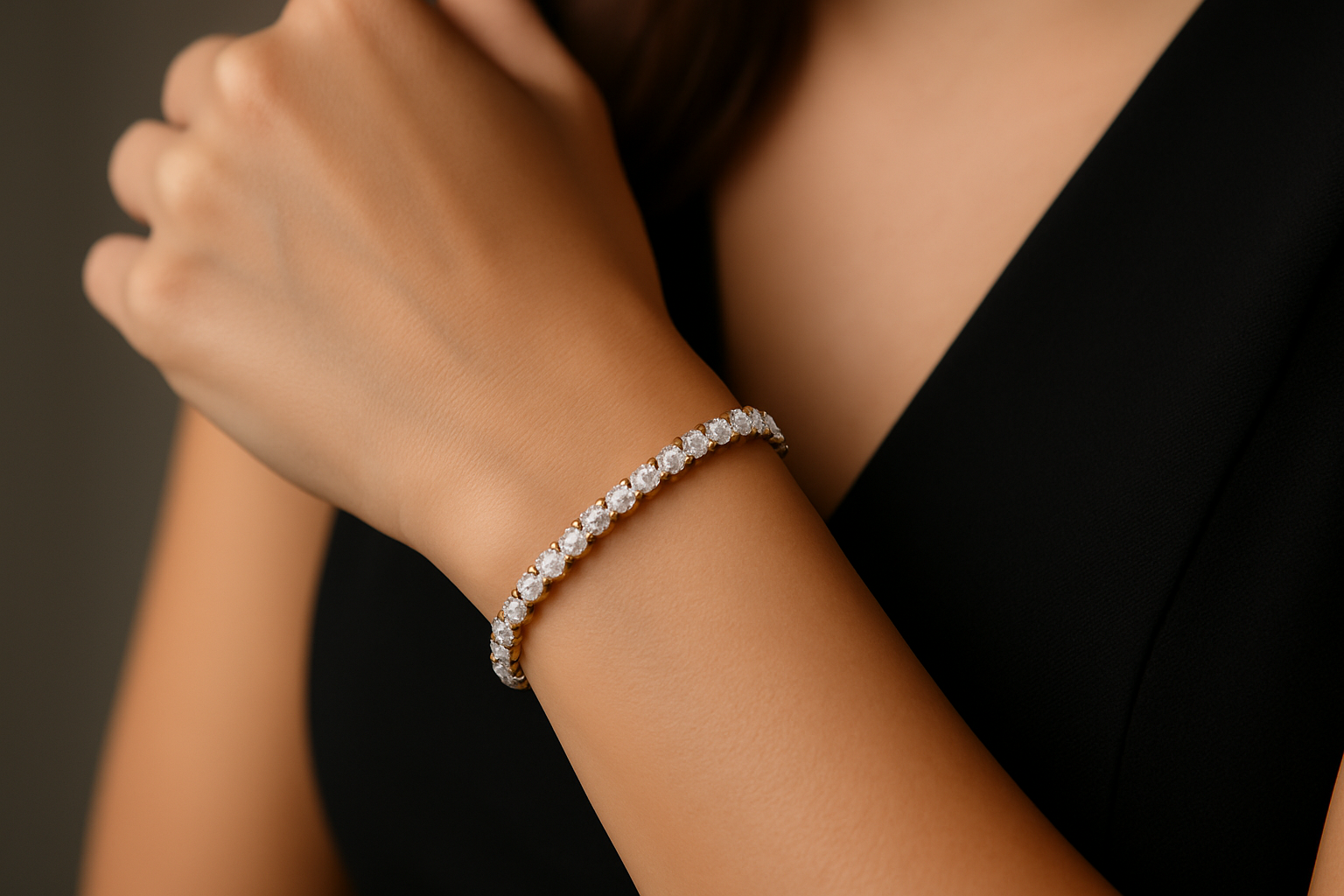
Tennis bracelets with diamonds form a continuous band of stones. A white gold model with 3 mm brilliant-cut diamonds weighs ~7 g and is suitable for both the office and the evening. The downside – it must be checked annually to see if the prongs have not loosened.
Tennis bracelet for men
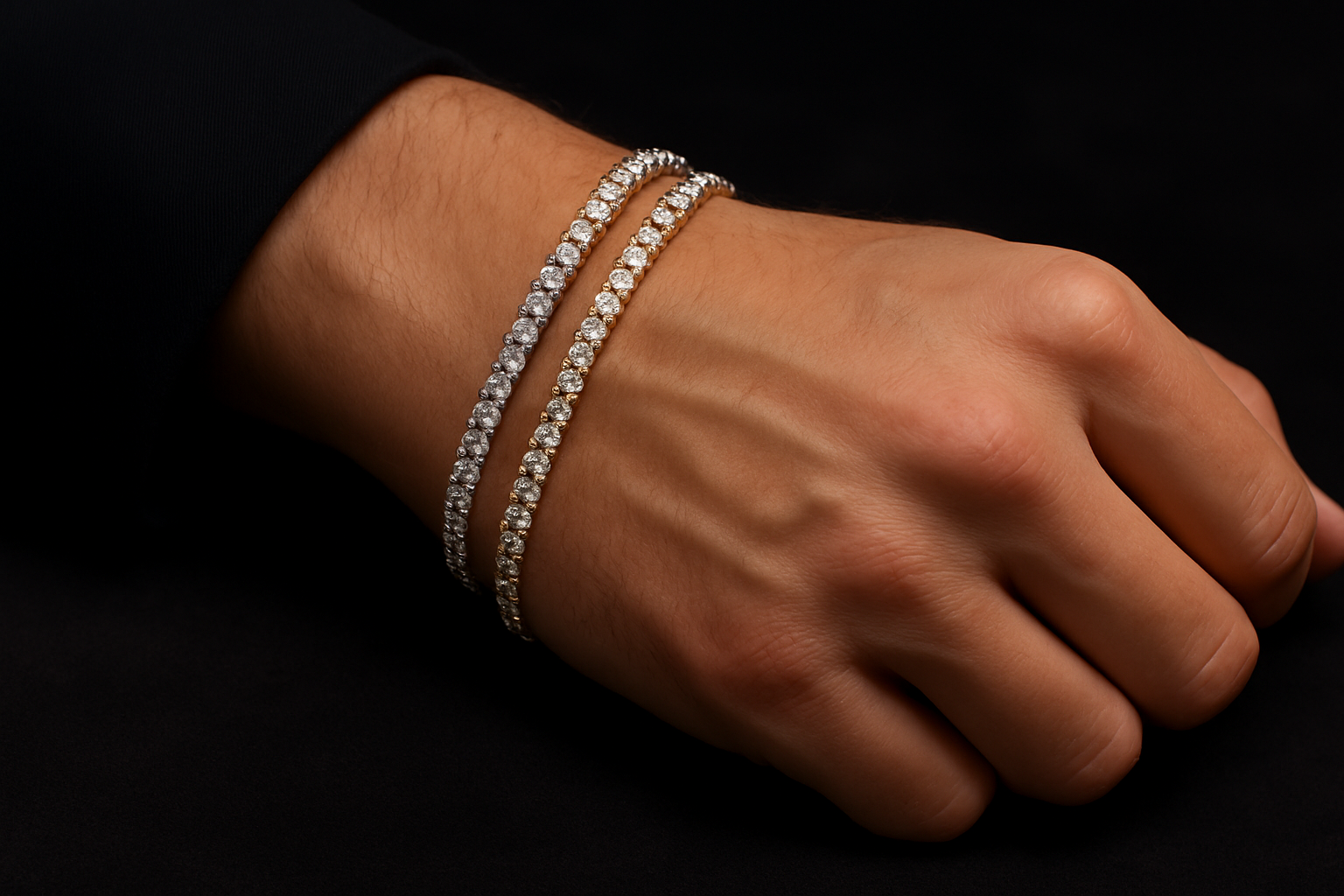
A men’s tennis bracelet is often made wider – 4 mm brilliant-cut diamonds on a white metal background. A sturdy box‑lock clasp with two safeties protects against unexpected unfastening.
Bracelets with diamonds for everyday use
A subtle gold bracelet with a solitaire diamond in the centre or small stones in individual settings is ideal for everyday wear, because if caught, the entire track of stones does not break.
Weave types: rolo, figaro and pigtail
Rolo links provide flexibility, figaro visually widens the gold bracelet, a pigtail weave looks modern but requires thicker gold. The more complex the weave, the higher quality the connections must be.
Which bracelet is best for a pendant
A bracelet with a diamond pendant must have a bail, the inside of which is at least 1,3× thicker than the link diameter, so that the pendant slides smoothly and does not twist.
A bail or a sliding pendant?
A bail allows you to change pendants, but can interfere with the clasp; a sliding solution keeps the bracelet flat, however limits the thickness of the pendant.
Bracelet with a letter pendant
A bracelet with an initial pendant becomes personalised. Choose a bail with an additional lobster clasp so that the pendant does not weigh down one side.
Bracelets with pearls – elegance and subtlety
Pearl bracelets stand out with a soft shimmer and classic forms. For quality, uniform pearl diameters and pearls separated by knots on a silk string are important – this way they do not rub against each other. A gold bracelet with pearls and individual brilliant-cut diamonds creates a modern contrast, while a white gold clasp emphasises the whiteness of the pearl. Pearls are sensitive to chemicals and moisture, therefore take off the bracelet before bathing and spraying perfume, and once a year restring the thread necklace so that the knots remain firm.
Yellow, white and rose gold
The warmth of yellow gold contrasts beautifully with white brilliant-cut diamonds, white gold highlights the colour of the stone, and rose gold creates a fashionable, romantic background; when choosing, it is important to take your skin tone and other jewellery into account.
The charm of white gold
White gold with rhodium creates a mirror background, so even SI1 clarity diamonds look whiter; however, the rhodium layer will need to be renewed every 2–3 years.
The warmth of yellow gold
Yellow gold radiates classic luxury, especially in combination with Princess cut diamonds; an advantage – small scratches are less visible.
The contrast of rose gold
A rose surface accentuates the whiteness of the brilliant-cut diamond. Such a gold bracelet with a diamond is suitable for romantic and bohemian looks.
Combining on the wrist: matching several bracelets
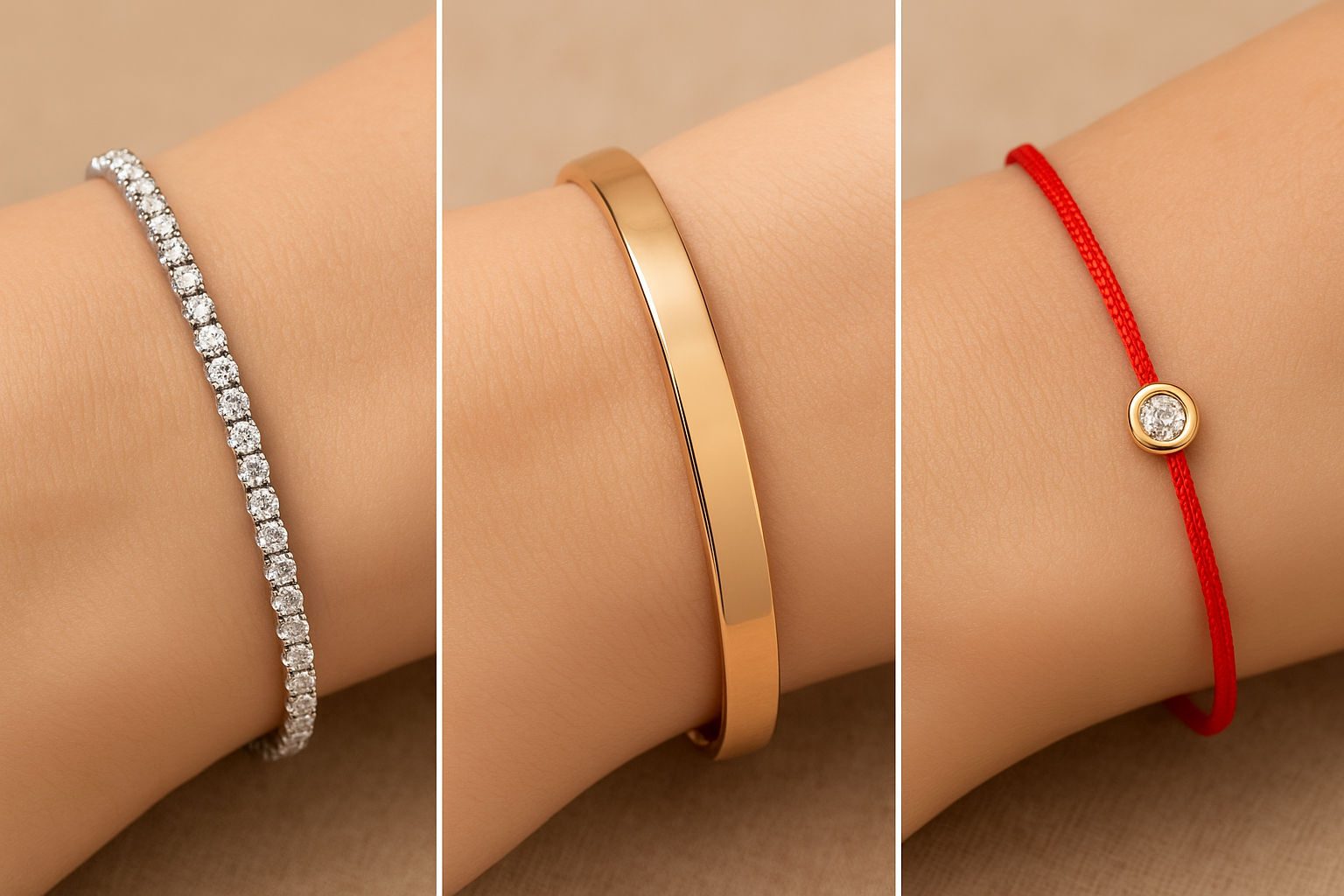
It is fashionable to combine gold bracelets with pendants and a tennis band. Choose different thicknesses and metal colours so that the contours of the bracelets differ clearly.
Prevention of bracelets tangling
Wear blocking rings or silicone stoppers between the bracelets; this way they move independently and do not scratch each other.
Bracelets and culture: symbolism and traditions
Bracelets have always been closely associated with culture and traditions. In different countries and communities, bracelets have acquired a distinct symbolism – from signs of protection to love or luck. For example, red string bracelets in our culture are often gifted as a symbol of protection, it is believed that they can bring happiness and protect against adversity. Bracelets with diamonds have become a symbol of luxury and elegance, often gifted on special occasions, in order to show exceptional attention or love. Gold bracelets, regardless of their colour or design, are often passed down from generation to generation as a family heirloom, giving meaning to the connection between the past and the present. In our traditions, bracelets can be not only a jewellery piece, but also a personal talisman, which reminds of important life events or the care of loved ones.
Popular gift occasions
A gold bracelet with a diamond – a frequent gift for an anniversary or birthday. A red string bracelet with a diamond is popular for the birth of a baby or the protection of newlyweds.
The history of the bracelet: from antiquity to today
The history of the bracelet goes back thousands of years – already in ancient civilisations they were an integral part of everyday life and festivities. In Egypt, bracelets made of gold and coloured stones symbolised wealth and the favour of the gods, while in China and Rome they marked social status or belonging to a certain community. Over time, bracelets acquired more and more meanings: they were gifted as a sign of love, friendship or protection. Today, bracelets with diamonds, red string bracelets and gold bracelets of various colours – white gold, yellow gold or rose gold – have become not only a part of style, but also of personal history. Each bracelet can reflect the owner’s values, memories or even pass on family traditions from generation to generation. Modern bracelets are made of gold, decorated with diamonds or other gemstones, while string bracelets retain their symbolic meaning even today
Tip: how to choose
Take into account the gold weight, diamond size, weave, length and clasp type. In our collection you will find white, yellow and rose gold bracelets that can become the accent of your everyday style or special occasion.