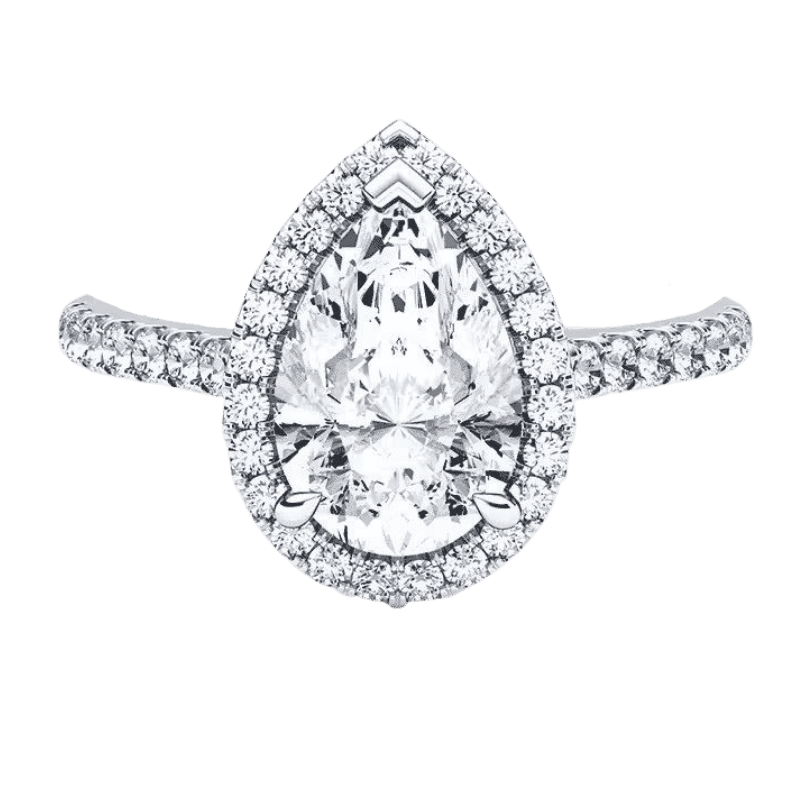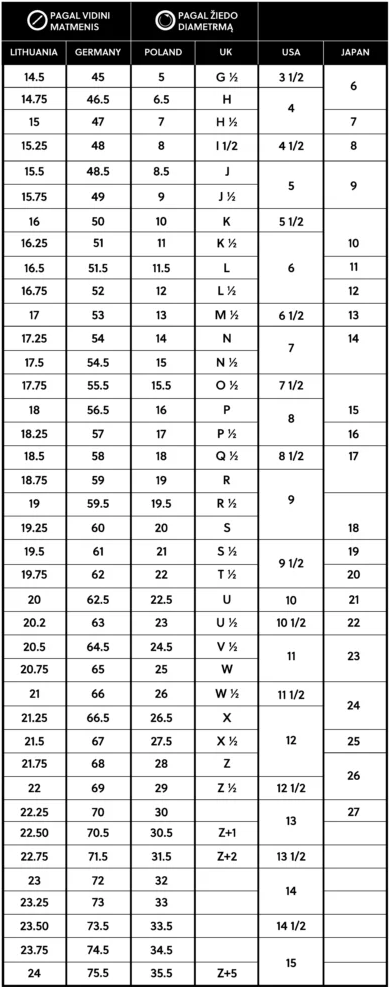
White gold – the symbol of modern love: natural champagne hue, icy rhodium and everything you need to know about white gold rings
Why white gold reigns in the engagement market
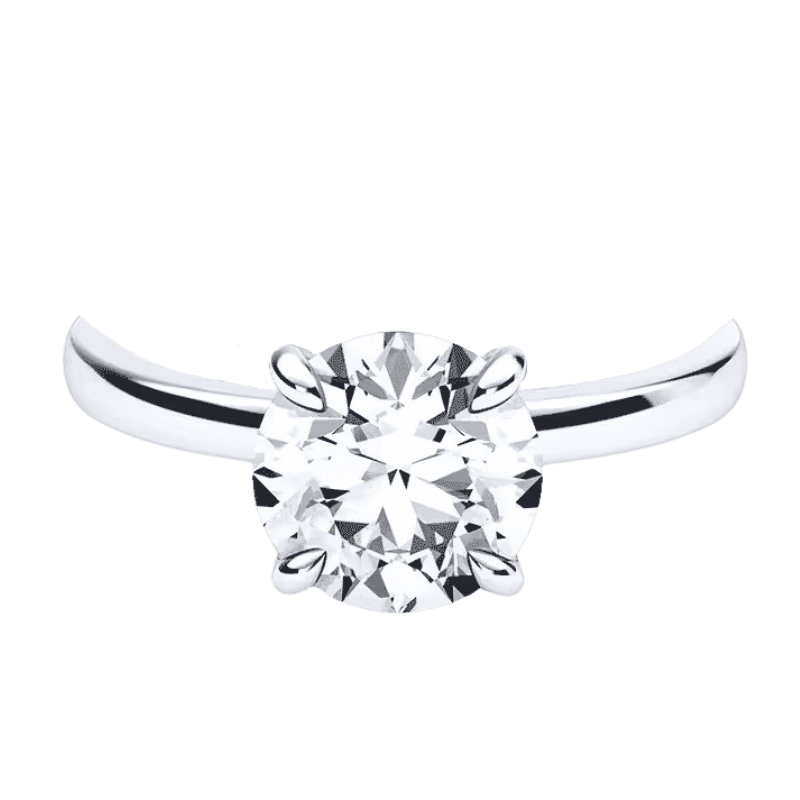
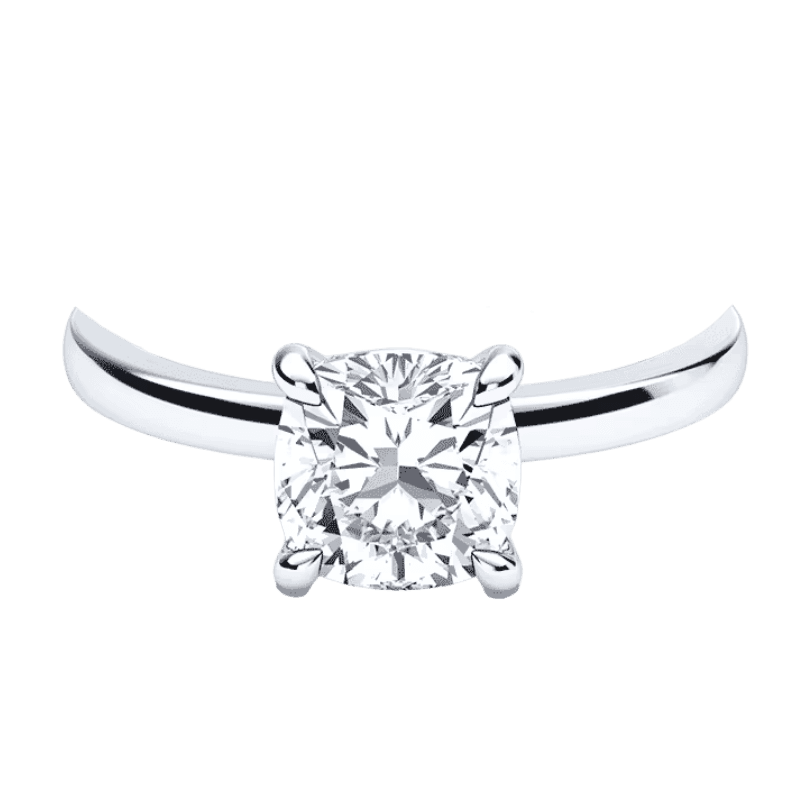
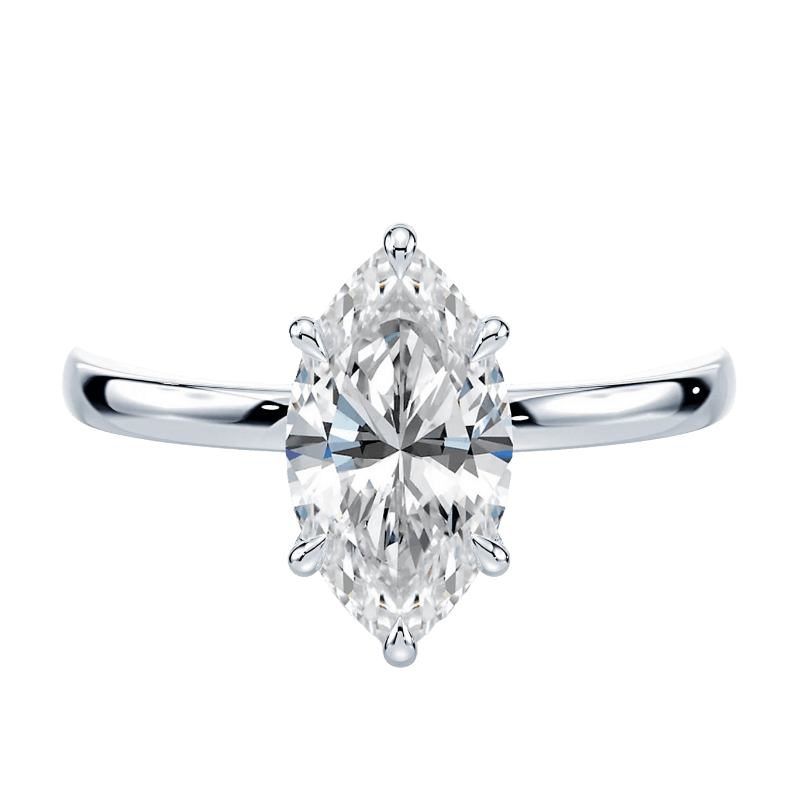
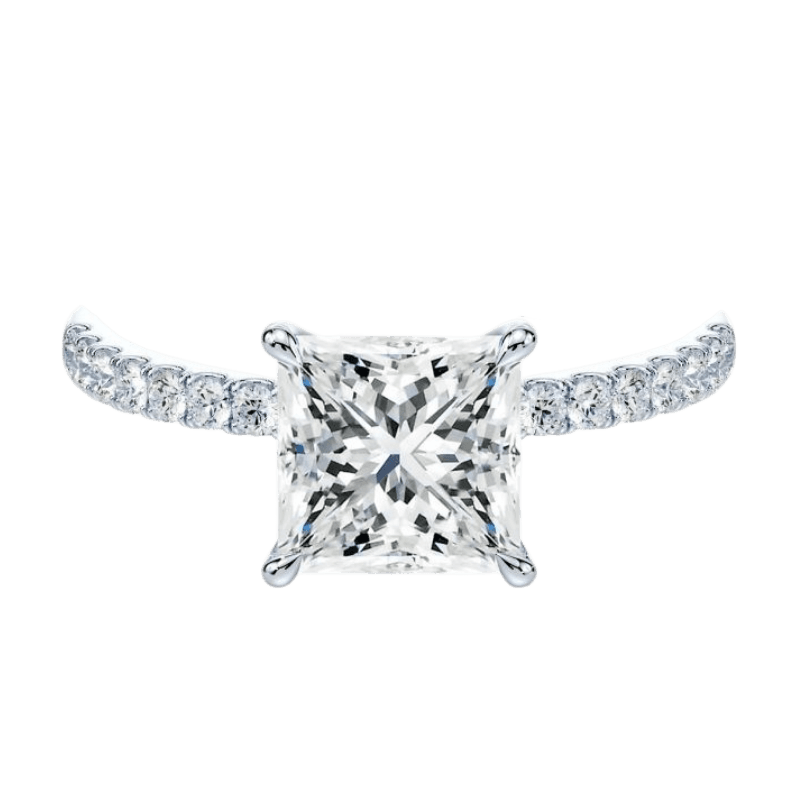
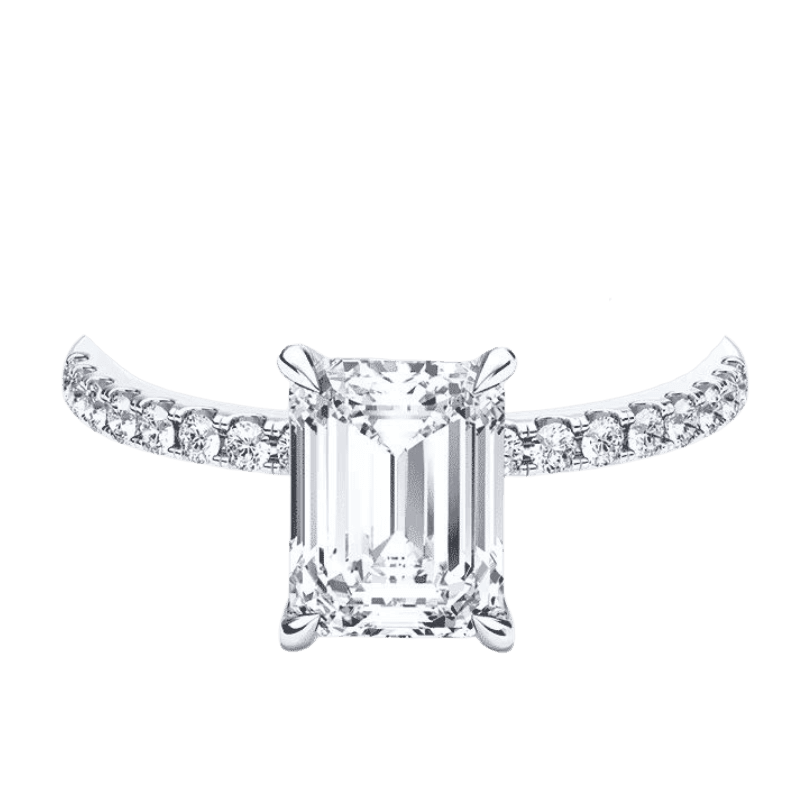
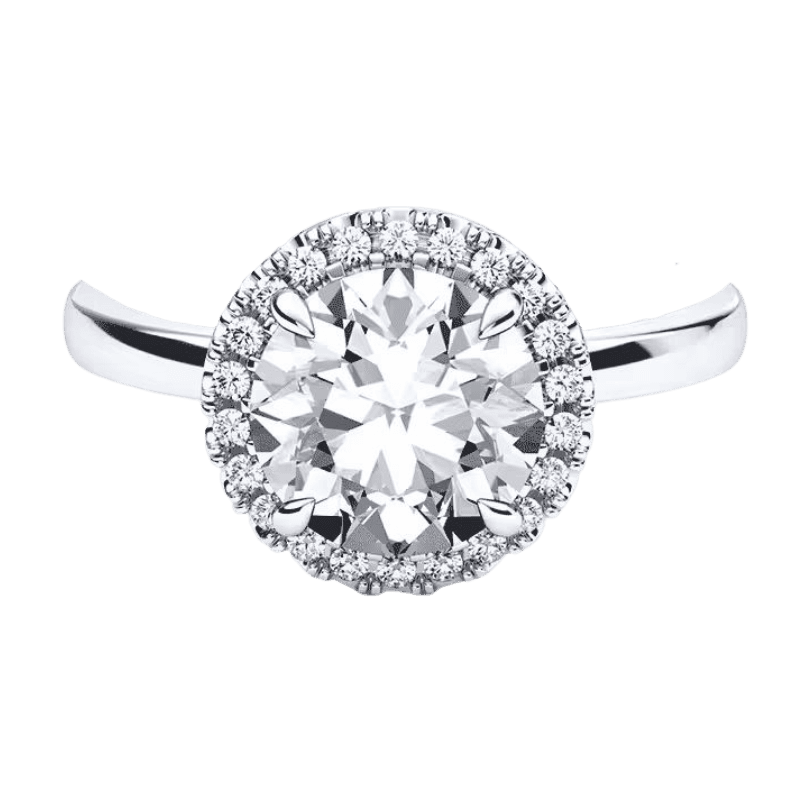
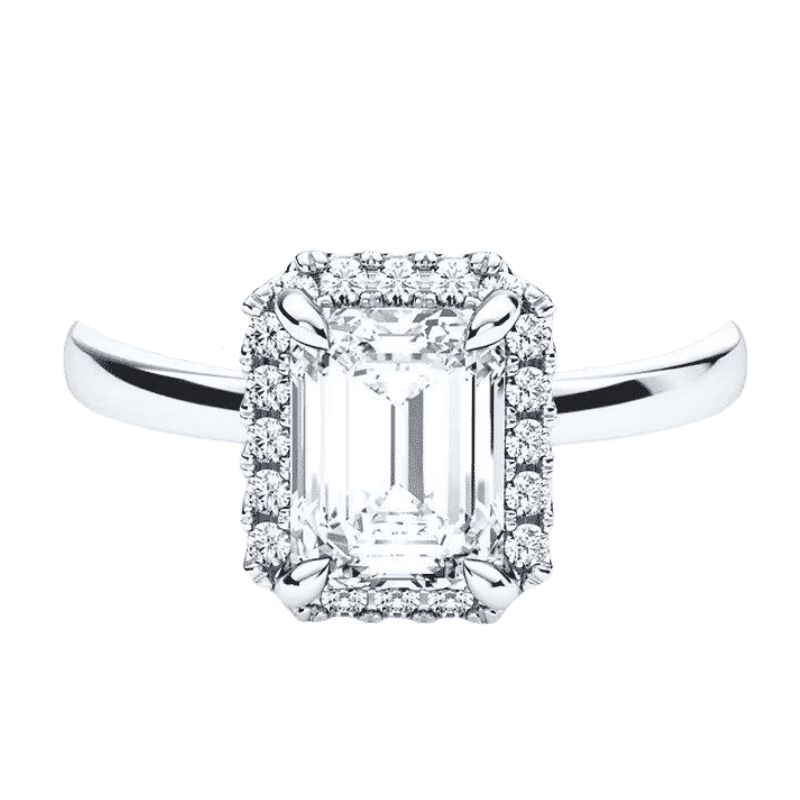
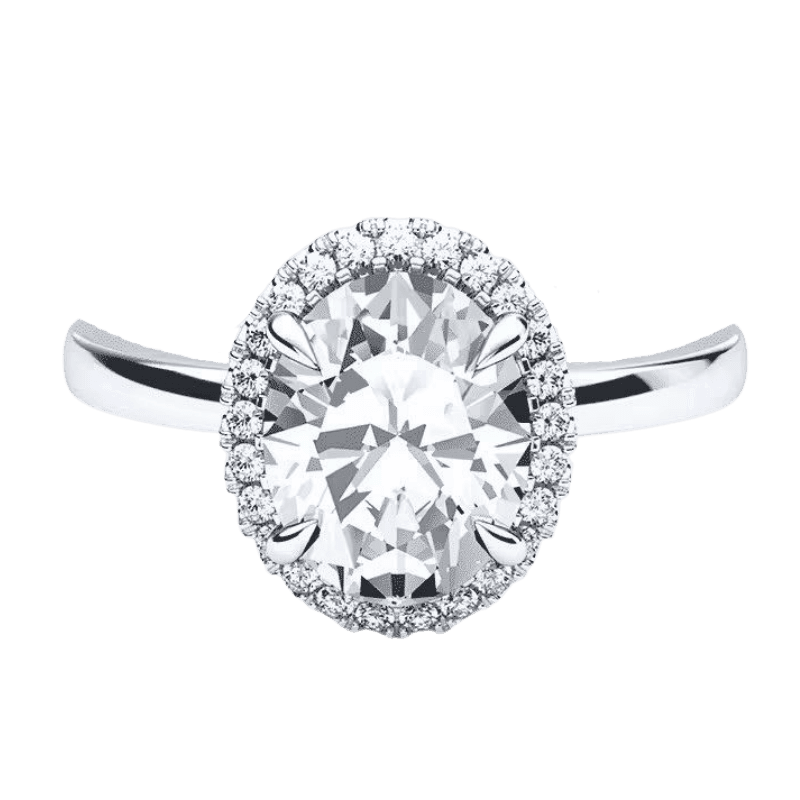
White gold rings have become the benchmark of modern romance, as they provide a neutral background for a diamond without a yellow tint. Gold rings are popular for their durability, quality and style, making them a frequent choice for engagements and weddings, highlighting their suitability for this special occasion. Jewellery trends show that white gold rings and white gold have outpaced yellow gold demand over the past decade, however a gold jewellery piece remains valued for its aesthetic value and traditions.
What is white gold and how its colour is born
White gold is a precious metals alloy in which gold is combined with silver, palladium or nickel proportions. These metals lighten the naturally yellow colour, so the surface of the alloy acquires a greyish-white tone. That is why white gold is called a “technological transformation of yellow gold” – it is not only a jewellery piece, but it is also important to recognise and evaluate the jewellery piece according to its marking or fineness, in order to ensure quality and authenticity. Furthermore, it is worth remembering that the truth was a traditional way to check gold authenticity, which today is often compared to modern methods such as fineness or carats.
Yellow, rose or white: the chemistry of colours and metals
The origin of the yellow hue is determined by 75 % pure gold and 12,5 % each of silver and copper. The rosiness of rose gold is provided by a larger proportion of copper, while white gold lightens when copper is replaced by palladium, silver or nickel. Thus, the colour is determined by what proportions of metals are added to the alloy.
Symphony of precious metals: proportions of silver, palladium, copper
The more silver, the whiter but softer the structure; the more palladium, the harder and more expensive the alloy. The amount of copper determines a warmer hue, which is why a rose or champagne tone becomes prominent in the rose or natural white gold version.
Fineness and carats: which gold fineness is the best?
The carat number (K) indicates the percentage of pure gold: 24 K = 99,9 % precious metal. In jewellery, the most common gold finenesses are 585 (14 K) and 750 (18 K). 585 gold is more practical as the rings are harder, and the price of gold pieces is lower. 750 white gold is warmer, therefore it is more frequently plated with rhodium so it does not turn yellow. It is also worth paying attention to the diamond carat weight in rings – the higher the diamond carat weight, the higher the value of the jewellery piece.
White gold fineness 585 vs. 750 vs. 950
585 white gold provides hardness and an affordable price, whereas 750 offers luxury and higher investment value. 950 fineness is more commonly found in platinum, but white gold rings would only lose hardness, so this fineness is rarely used. Each fineness has a hallmark with which the assay office marks the products in accordance with the laws and standards of the Republic of Lithuania regulating the marking and checking of gold fineness.
How to check gold: the guarantee of the Lithuanian Assay Office
To make sure that the ring matches the declared fineness, it is best to contact the laboratory of the Lithuanian Assay Office. There, a spectrometer confirms the metal composition, and an official marking – a hallmark – is stamped on the piece.
Gold and rhodium: the power of platinum metals
Gold is a soft standard of a precious metal, while rhodium (Rh) is a harder member of the platinum metals family. Rhodium is used for surface plating, as its shine and corrosion resistance surpass even platinum.
Rhodium: what it is, who discovered it and why it is expensive
Rhodium is a silvery-white metal identified by William H. Wollaston in 1803. Its rarity (due to low extraction in South Africa) and demand in automotive catalytic converters cause the rhodium price and rhodium price to fluctuate more than those of gold or platinum.
Rhodium price and its fluctuations
In midsummer 2025, a troy ounce of rhodium cost about 5 700 USD. Demand from industry caused price spikes up to 30 000 USD / oz during the pandemic period, so plating a ring with rhodium costs more than with a platinum layer.
Natural white gold: a warm champagne hue
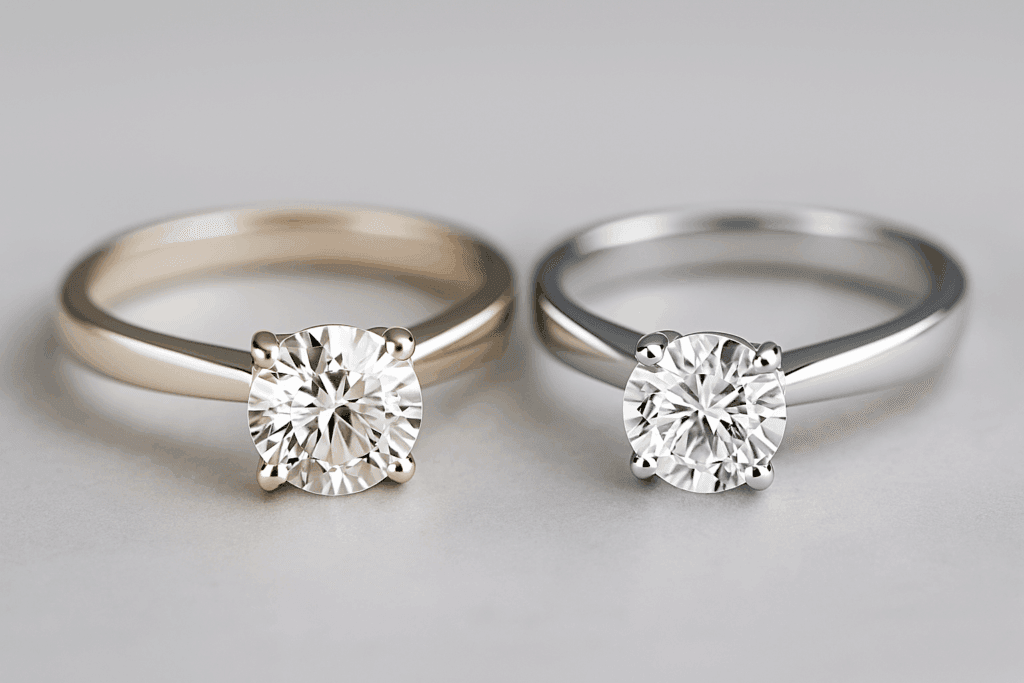
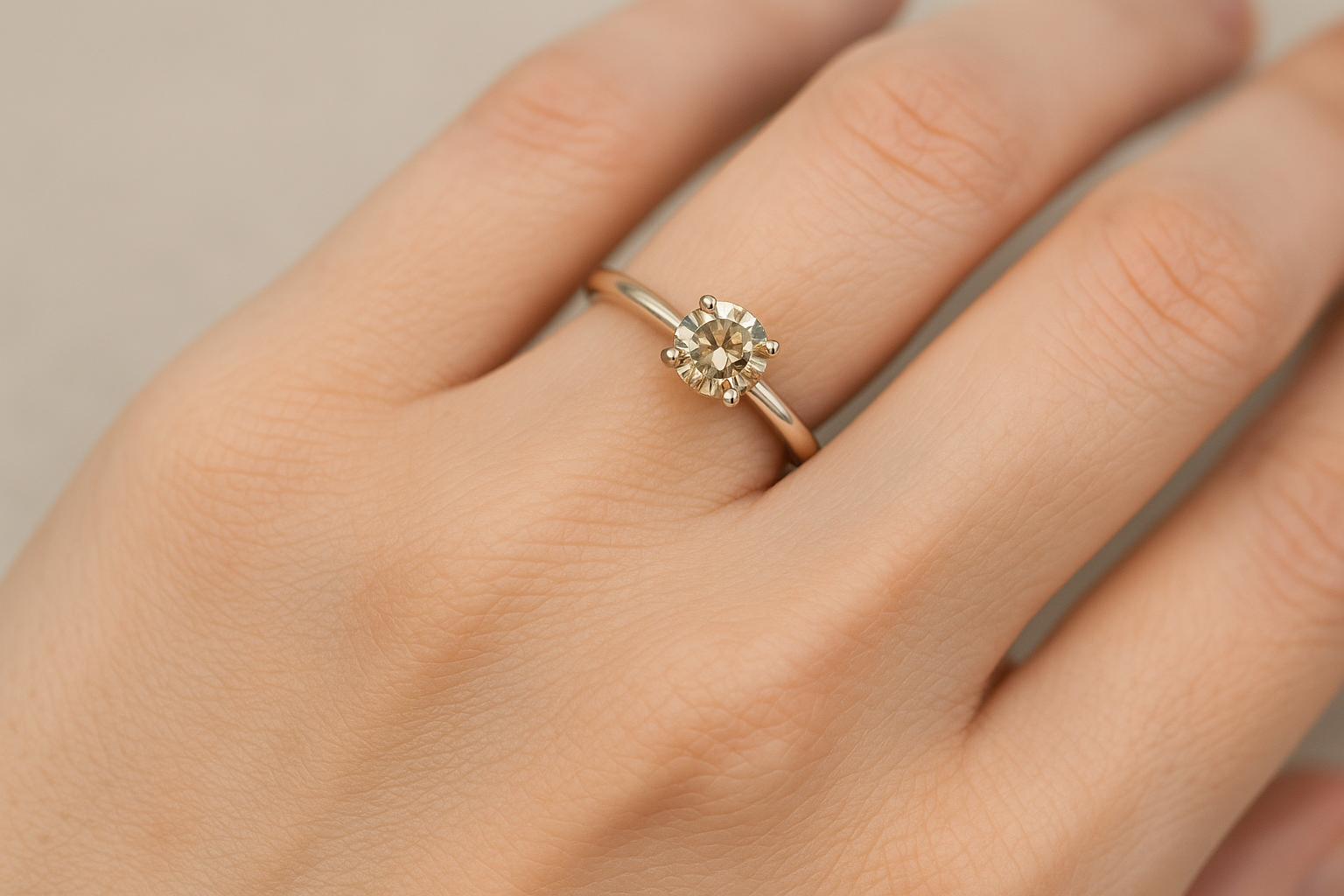
Natural white or “champagne” gold retains a soft yellowish tone. Such a white gold ring pairs ideally with pink sapphires or champagne diamonds, and the jewellery piece does not require periodic plating. It is an excellent choice for those wanting less maintenance and a warm hue.
Rhodium-plated white gold: icy shine without impurities
A thin (~0,3 µm) layer of rhodium on plated rings provides the whiteness of winter ice, completely neutralising the yellowish background. A white gold ring with such a coating allows a “D” colour brilliant-cut diamond to shine without colour distortions.
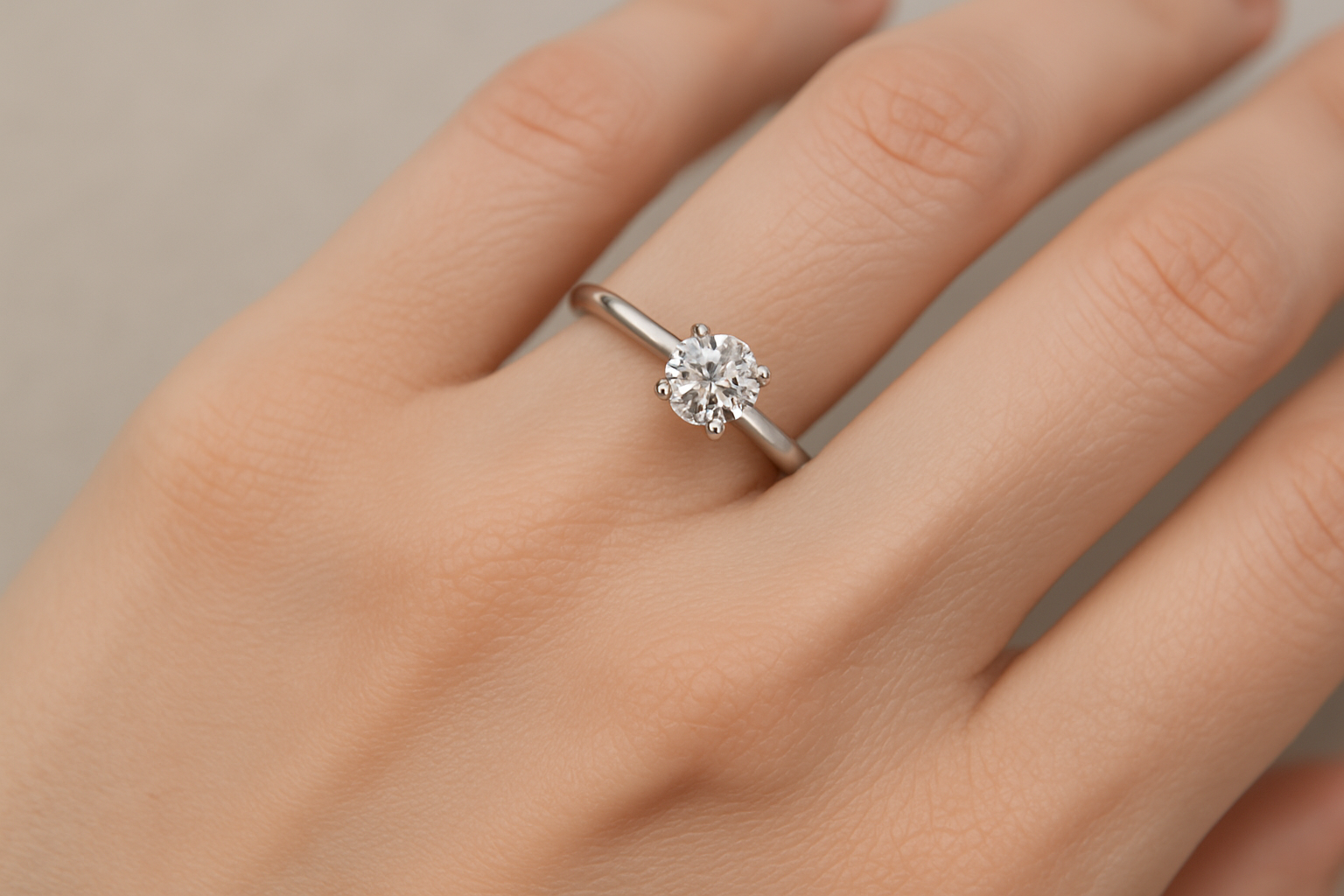
White gold rings with diamonds: the impact of colour on the gemstone
The surface of a diamond reflects the surroundings: a yellow surface will impart a warm hue, while a rhodium mirror – crystal clarity. Therefore, for stones of a high colour category, white gold rings with rhodium are almost always recommended.
Rhodium plating of engagement and wedding rings
Engagement rings and wedding rings are often rhodium-plated so that the couple’s jewellery pieces match in colour, especially if one chooses platinum and the other – white gold. Plating takes a few minutes in an electrochemical bath and adds ~5–10 % to the final price of the gold rings.
The price of white gold rings: the influence of fineness, design and rhodium
The price of white gold depends on the fineness, weight, rhodium layer and gemstone carats. A minimalist 585 white gold ring without gemstones costs from 350 €, and the same model with a 0,30 ct diamond – from 1 000 €. Gold ring prices at the 750 level rise by about 20 %.
Gold style: minimalist, vintage, bohemian
Contemporary jewellery pieces match both street fashion and a luxurious evening look. The gold style can be minimalist (a thin single band), vintage – with filigree details – or bohemian, when bands of yellow, rose and white alloy are woven into one ring.
Design possibilities for a white gold ring: from classic to unique
White gold rings open up unlimited design possibilities – from timeless classics to an exclusive, individual style. These rings are made from a white gold alloy, in which gold is combined with metals such as palladium or rhodium to achieve a light, elegant hue. Due to their durability and longevity, white gold rings are perfectly suited for weddings or engagements. The design can be minimalist, with a subtle shine, or expressive – decorated with diamonds or other gemstones, with details or even personal engravings. Gold fineness, for example, 585 or 750, determines not only the value of the ring, but also its hue and sturdiness. Whether you choose a classic or modern white gold ring, every creation can become a unique symbol of your love.
Maintenance: how to preserve the white gold hue
Take off your jewellery pieces when doing sports, swimming in a chlorine pool or working with household chemicals. The rhodium layer should be renewed every 12–24 months – the procedure is inexpensive, and the shine returns instantly.
An eco-friendly choice: a responsible precious metals chain
When choosing a ring, ask whether recycled gold is used in the alloy and whether the suppliers have a Responsible Jewellery Council certificate. This way you contribute to a sustainable precious metals and gemstones industry.
Gold application areas: more than just rings
Gold is not only rings or other jewellery pieces, but also a highly valuable metal widely used in various areas. Gold jewellery pieces, such as rings, bracelets or earrings, are valued for their beauty, longevity and gold fineness, which indicates the amount of pure gold in the product (most often 585 or 750). However, gold is also irreplaceable in the electronics industry due to its conductivity and resistance to corrosion, and in medicine – due to its biologically inert properties. The Lithuanian Assay Office plays an important role in checking and marking gold fineness, thus ensuring the quality and value of jewellery pieces and other products. So gold is not only a symbol of luxury, but also of technological progress, accompanying us both in everyday life and on special occasions.
Advice: which white gold ring to choose?
If you value a warm champagne hue and minimal maintenance, choose natural 585 white gold. If you desire an icy shine and do not mind periodic rhodium plating, choose the rhodium-plated 585 version. The most important thing is a transparent origin, official marking and a design reflecting your love story. Let your new gold jewellery piece radiate light for decades!
The history of wedding rings: from antiquity to today’s symbol of love
The history of wedding rings dates back millennia – from ancient Egyptian times, when the first rings were made from simple plant fibres or metal, to modern luxurious gold and platinum pieces. In ancient Rome, rings were already being made from precious metals, and in the Middle Ages, wedding rings became not only a sign of love, but also of status, often decorated with gemstones. Today, wedding rings are made from various materials – white gold, yellow gold, platinum – and every choice reflects the couple’s values and style. Gold fineness, such as 585 or 750, indicates how much pure gold is in the ring, and determines both the quality and value of the ring. Modern rings often combine tradition with innovation, which is why every couple can find a symbol close to their heart, made from the highest quality precious metals and decorated with exclusive gemstones.
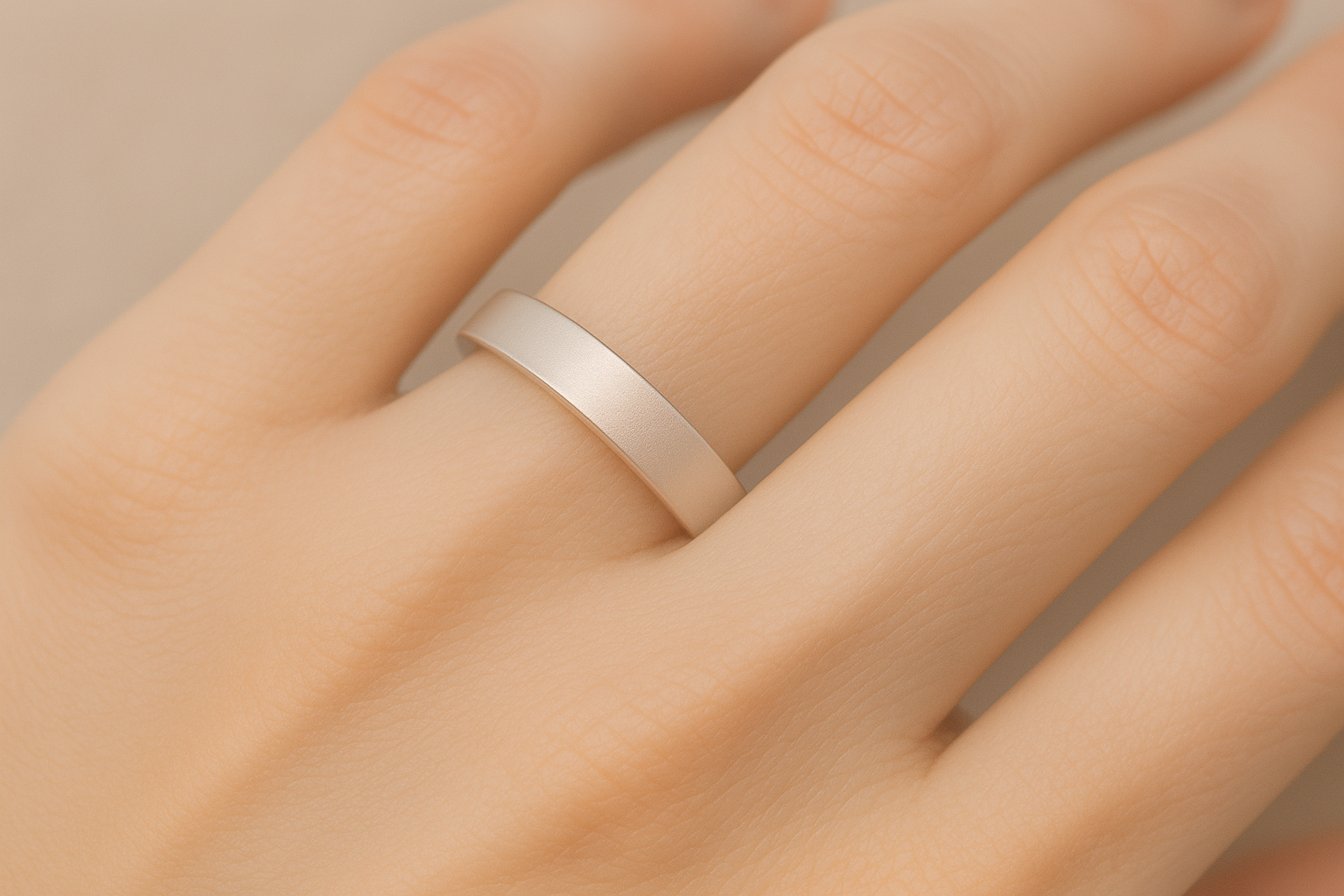
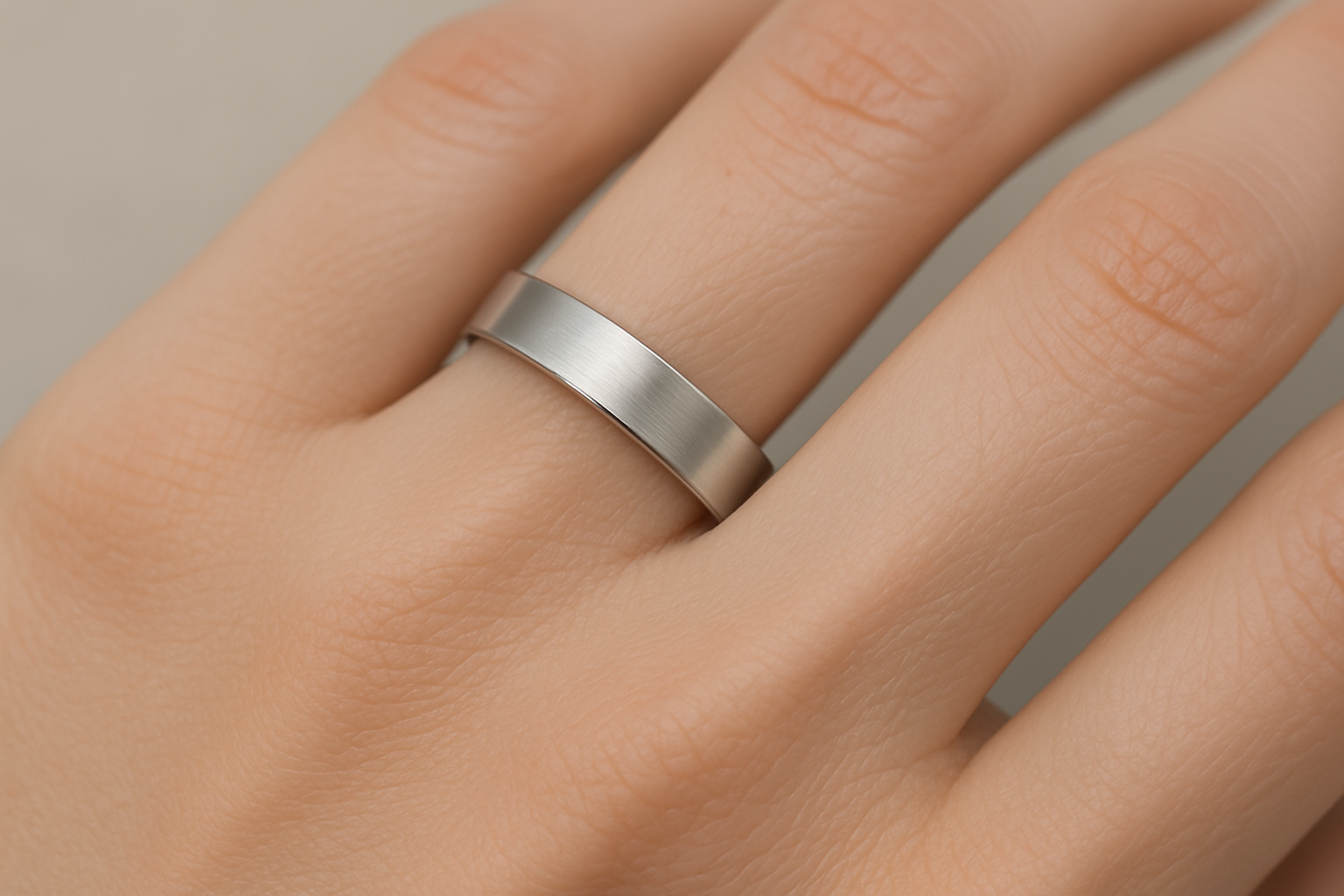
The meaning of wedding rings: what does a ring on the finger symbolise?
A wedding ring is not only a jewellery piece, but also a deep symbol of love, fidelity and an eternal union. Slipped on the finger, it reminds of the couple’s promise to be together for a lifetime. Wedding rings are made from various precious metals, such as gold, silver or platinum, and are often decorated with diamonds or other gemstones that give the ring uniqueness. The gold colour – yellow, white or rose – allows every couple to choose a ring that matches their personality and sense of style. Rose gold rings stand out with a warm, passionate hue, which symbolises love and energy, while white gold rings enchant with their subtlety and modernity. Every ring, regardless of colour or gemstones, becomes a unique sign of the couple’s love story.